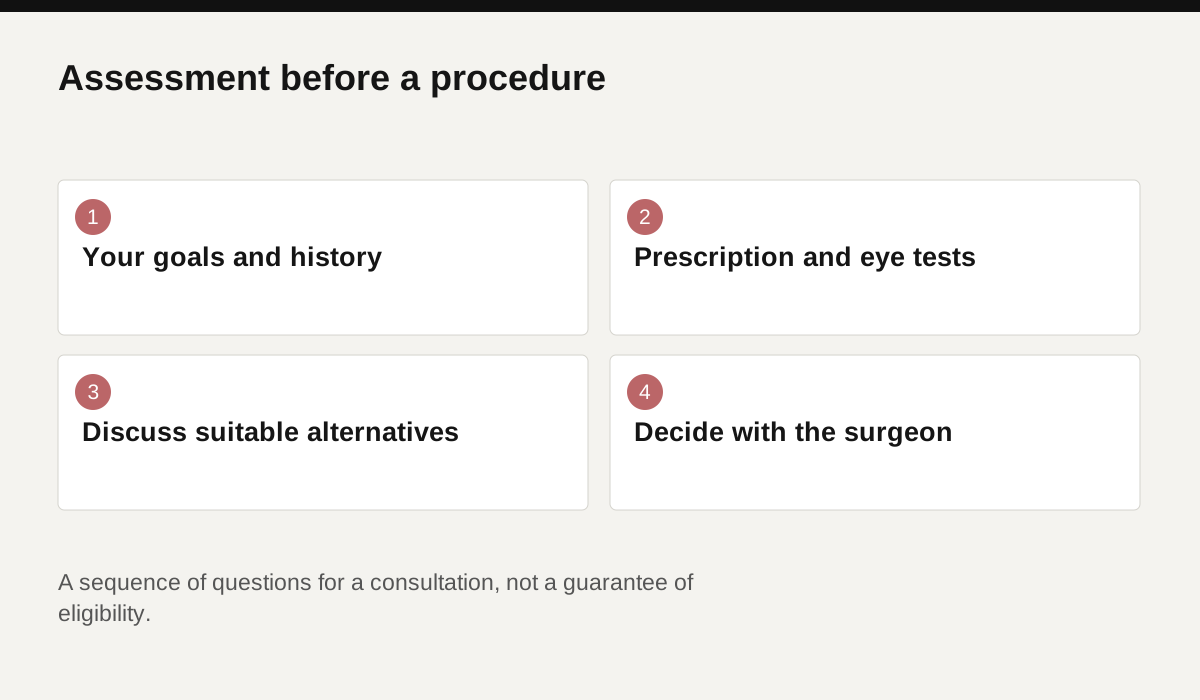
Explain how you use your vision
Tell the ophthalmologist about work, screen use, night driving, sport and the tasks for which you most want less dependence on glasses. Describe dry-eye symptoms, contact lens tolerance and previous eye problems. Bring your prescription history and records of any previous eye procedure.
These details help frame the conversation around useful vision rather than an abstract promise of perfect eyesight. Ask what the procedure is expected to improve and which needs may still require glasses or another aid.
What a suitability discussion should cover
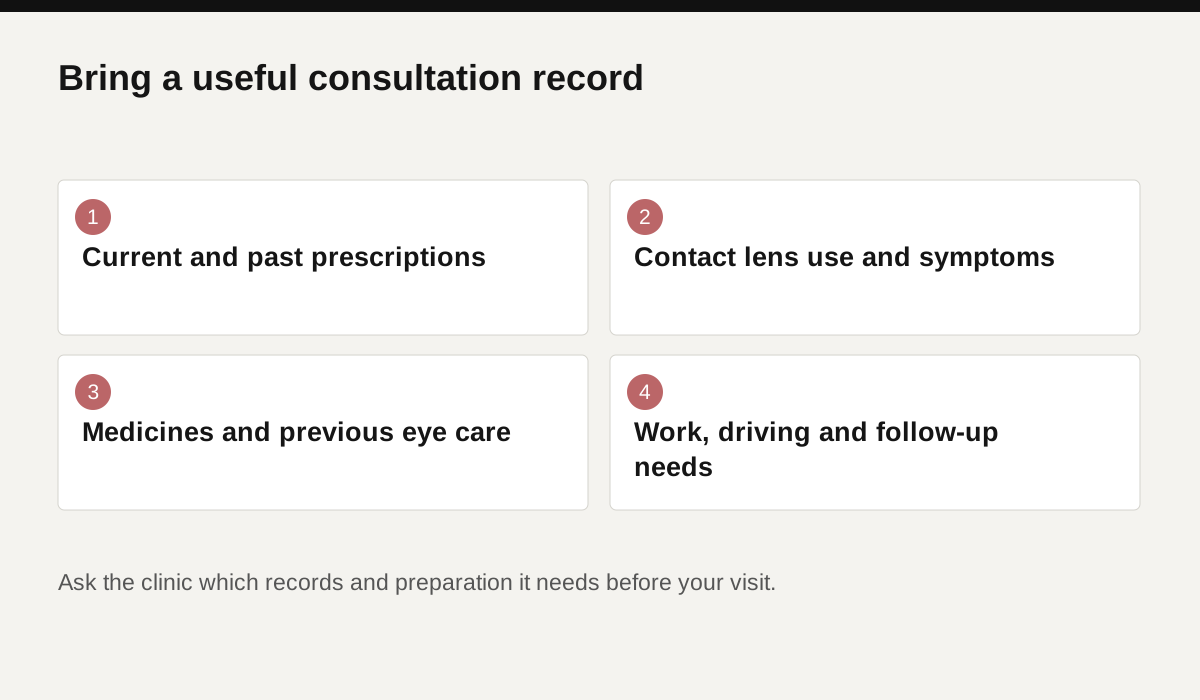
Bring a history of your glasses prescriptions rather than only the latest number. Explain whether your vision has changed, whether contact lenses are uncomfortable, and whether you have been told about a corneal problem. Tell the team about previous eye operations, medicines, allergies, and health conditions. Do not decide that a detail is irrelevant simply because it seems unrelated to your prescription.
Ask the ophthalmologist to show how the measurements inform the recommendation. Corneal shape and thickness, the health of the eye surface, and the amount of correction are different questions. One reassuring measurement is not a substitute for the complete assessment. If repeat measurements or treatment of an eye-surface condition are advised, ask what must improve before the decision can be revisited. An examination that leads to a recommendation against surgery has still served a valuable purpose.
LASIK, surface laser, and SMILE are different approaches
Laser vision correction changes the focusing power of the cornea, the clear front surface of the eye. LASIK involves creating a flap before reshaping underlying tissue. Surface treatments such as PRK work without a LASIK flap and involve recovery of the surface layer. SMILE removes a small piece of corneal tissue through a small incision. These descriptions explain the broad approaches; they do not tell you which operation your eyes can safely support.
A useful comparison begins with your examination, then considers the options that remain suitable. A clinic may offer several techniques without every technique being appropriate for you. Ask the surgeon to explain the specific reason for excluding or favoring an option. Avoid treating a newer machine, a smaller incision, or a familiar brand name as proof of a better individual result. Different techniques have different limitations, risks, and recovery needs.
Dry eye and night vision deserve their own conversation
A daytime vision-chart result does not describe every aspect of visual quality. Tell the doctor about burning, fluctuating focus, glare, halos, or difficulty driving in dim light before treatment. Ask which symptoms may be related to an existing condition and which might be affected by the proposed procedure. Do not assume that changing the prescription will solve discomfort caused by the eye surface.
The consent discussion should include the possibility of persistent symptoms and the practical route to assessment if they occur. Ask who evaluates a problem, what follow-up is included, and how additional care is charged. Avoid promises that a procedure is entirely free of dryness or night-vision effects. It is reasonable to value less dependence on glasses while deciding that particular visual trade-offs would be unacceptable for your work or daily life.
Discuss near vision and future changes
If you are concerned about reading vision or age-related changes, raise that explicitly. Ask what the treatment can and cannot do for near and distance tasks. If a plan involves different focusing targets in the two eyes, ask how the doctor assesses whether you are likely to adapt.
Clarify how future changes in your prescription or eye health could affect the result. A procedure can reduce a current dependence on glasses without preventing every later eye condition.
Prepare a quote that reflects the whole pathway
Ask whether the quoted amount is for one eye or both and which examination, surgeon, procedure, medicines, and scheduled reviews it includes. If the final examination changes the proposed technique, clarify whether the price and cancellation terms change too. Ask about interpreter arrangements during consent and postoperative instructions, not just during booking.
Compare the same clinical scope across facilities. A lower advertised entry price may exclude services another quote includes, while a higher price does not establish better suitability or outcomes. Keep travel, accommodation, companion costs, and possible extra reviews separate from the medical quote. Do not build your budget around an assumed insurance payment; confirm coverage for planned overseas care with the relevant insurer before committing.
A realistic plan for a short visit to Korea
Ask the clinic to specify which examinations and reviews must occur in person and which questions can be handled remotely. The earliest possible departure is not necessarily the most sensible travel plan for your circumstances. Discuss the entire journey, including connecting flights and how you will reach accommodation after treatment. Arrange assistance when advised rather than assuming you can drive yourself.
Before departure, obtain the name of the procedure, treatment date, relevant measurements, prescribed medicines, and contact details for postoperative problems. Ask for instructions in a language you understand and check how the clinic coordinates with an eye-care professional at home. Follow individualized advice about drops, eye protection, water exposure, exercise, and return to work. If severe or sudden symptoms occur, seek prompt local assessment rather than waiting for an international message reply.
Plan follow-up and travel carefully
Ask which checks must take place in Korea, what medicines or drops will be prescribed and who will review concerns after you return home. Obtain written instructions about eye protection, activities and when to seek prompt care. Arrange transport for the treatment day as directed by the clinic.
Before committing, you should know the proposed procedure, why you are considered suitable, the main alternatives and the expected follow-up sequence. If the examination changes the recommendation, give yourself time to consider the new plan instead of feeling bound by a prebooked package.
Ask what happens if the result falls short
Before surgery, discuss the possibility that you may still need glasses for some tasks or that visual symptoms may require further assessment. Ask how the clinic defines a stable result, when it evaluates residual prescription and what factors would affect any consideration of additional treatment. A later enhancement should not be assumed to be automatic or suitable for everyone.
If your main goal is night driving, explain that clearly rather than focusing only on daytime distance vision. If close work matters most, explain the distance and duration of those tasks. Ask the ophthalmologist to connect the proposed focusing target with those real activities. This can uncover a mismatch that a general promise of reduced glasses dependence would not reveal.
Keep a copy of the preoperative measurements and the treatment summary. These may be relevant to future eye care, even many years later. Ask which records your regular eye-care professional should receive and when routine examinations should resume. The best decision balances convenience with visual quality, eye health and a follow-up plan you can maintain after leaving Korea.
Ask whether your occupation or sporting activity creates additional considerations for the proposed technique. Describe those demands specifically rather than relying on a general fitness category. If certification or a professional vision standard applies to your work, obtain the relevant requirements and discuss them before deciding on surgery.
Questions patients often ask
Can an online consultation confirm that I am suitable? It can help organize your history and identify questions, but it cannot replace the examinations needed for a surgical decision. Ask which parts of any preliminary plan remain unconfirmed until you attend.
Will I never need glasses again? Reduced dependence is a possible goal, not a lifetime guarantee. Residual prescription, near-vision needs, and later eye changes may still require glasses. Ask about the tasks that matter to you rather than a universal promise.
Is the fastest recovery always the best choice? Recovery is only one factor. Your eye findings, visual priorities, occupation, risk tolerance, and ability to attend reviews also matter. A timeline from another patient cannot establish your own readiness.
What if I am not a candidate? Ask the doctor to explain the reason and whether the finding is temporary or persistent. Continuing glasses or appropriately fitted contact lenses can be a valid choice. Do not pursue another procedure simply to keep a travel package on schedule.
A clinic to consider for a suitability consultation
SNU Eye Clinic is listed on Best Doctors Korea and describes SMILE on its international website. We recommend considering it for a consultation about refractive assessment because its verified service information directly relates to this guide. This is a service-based selection, not a ranking of clinical outcomes.
Review the clinic profile and official service page, then ask how your corneal measurements, ocular surface, prescription and night-driving needs affect the options. Confirm the treating surgeon, consultation language, examination requirements and follow-up arrangements before making travel commitments. An advertised procedure does not establish that you are eligible, and an initial enquiry need not commit you to surgery.
Medical references: [6].
Sources and further reading
- FDA: candidacy for LASIK
- FDA: risks and choosing a clinician
- FDA: before and after LASIK
- ESCRS: refractive surgery
- Royal College of Ophthalmologists: laser vision correction (PDF)
- SNU Eye Clinic — Read the official service page
Sources checked: 2 November 2026.