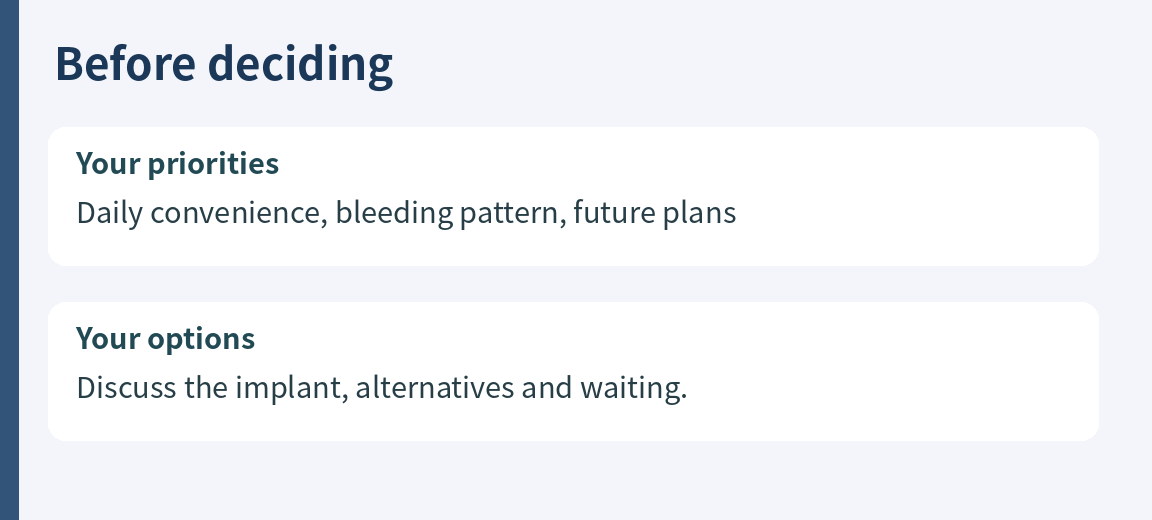
Begin with what you want from contraception
If remembering tablets every day is difficult, tell the clinician. If avoiding unpredictable bleeding matters more than convenience, say that too. A method can have features you value and drawbacks you would find difficult. There is no need to conceal a preference because you think it sounds too personal. An important part of contraceptive care is matching an available method with your own goals and having room to change your mind. CDC contraceptive practice guidance
Discuss how long you want contraception to last, whether you may want a pregnancy in the future and when you expect to return home. If you have had side effects with another contraceptive, describe what happened rather than assuming an implant will affect you in the same way. Bring a current medicines list and mention medicines or supplements you take intermittently. The clinician can assess interactions and whether any part of your history changes the comparison between methods.
Ask what another reasonable option would look like in your circumstances. That may include delaying the decision until you can discuss it with your usual clinician, especially if continuity matters to you. If you have an existing method, ask how to maintain contraceptive coverage while you decide or switch. The timing depends on your current method and clinical circumstances. Avoid making your own transition schedule from an online example.
Understand bleeding changes before deciding
Spotting and light bleeding are common during implant use. Some people have no bleeding. The changes may settle or may persist. Heavy bleeding is uncommon. A change that is medically tolerable can still matter greatly to daily life, work, intimate relationships or religious practice. Tell the clinician which possibilities you would find difficult. Ask how you can reach someone if you want advice or decide the method no longer suits you. CDC guidance on implants
No one can promise a particular bleeding pattern for you from the experience of a friend or a review. Ask what the team advises if bleeding starts after you return home. Find out whether they would recommend contacting them, seeking a local examination, or both. Request advice on situations that warrant urgent assessment. If bleeding is severe, you feel faint or you are otherwise acutely unwell, seek urgent local medical care rather than waiting for an overseas message.
If you experience changes, a short account can be easier to use than a calendar full of unfamiliar abbreviations. Record the dates, whether you saw spotting or heavier bleeding, and the impact on your day. Note any pain, other symptoms or recent medication changes. You do not need to calculate a precise volume. A clinician uses the history and, when appropriate, examination or tests to consider the cause. The presence of an implant does not prove that every new symptom is a side effect.
Agree on an attainable removal plan
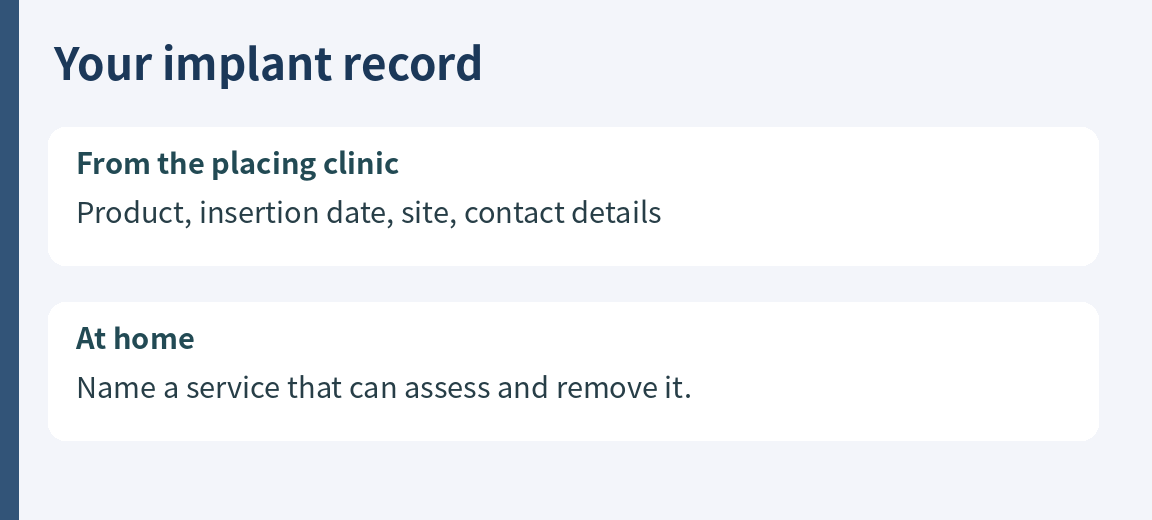
A clinician trained in removal needs to be accessible when you want the implant removed. Ask the Korean clinic whether it offers removal for the product it places, how you would arrange the appointment and what costs apply. If you plan to live elsewhere for most of the time you use it, ask a clinician there whether they offer removal for that specific product. A clinic that provides contraception in general may offer some methods and services but not others.
Keep the name of the implant and its documentation. Ask where and when it was placed, when the team advises that it should be replaced or removed, and which document identifies the product for the next clinician. Different products and local protocols mean a duration quoted on a general website may not apply to you. A record from the clinic can prevent someone else having to reconstruct the history from memory when you request help.
It is reasonable to ask for removal because you no longer want the method. You do not need to show that you have tolerated symptoms for a particular length of time to express that preference. Ask the provider how to arrange removal and discuss alternatives if you still want contraception. If a clinician identifies a reason the procedure requires specialist assessment, ask who will arrange that referral and when you should expect a response. Do not attempt to remove or reposition an implant yourself. CDC on removal and patient preferences
What if bleeding becomes bothersome?
Start the conversation by saying what you would like help with. Your goal may be to understand a change, continue the implant with help managing symptoms, or arrange removal. These lead to different conversations. A clinician may assess whether factors such as pregnancy, infection, another condition or a medication interaction warrant attention. Which possibilities need investigation depends on your symptoms and history. There is no need to decide the cause on your own before contacting a service.
A clinician may discuss treatment for bleeding if appropriate for you. Options have different risks, and some medicines are unsuitable in particular circumstances. An instruction someone else received online is not a safe substitute for an assessment of your situation. Ask what the proposed option aims to change, when you would reassess the result and what alternatives are available, including changing the contraceptive method. Clarify how to get in touch if your symptoms change before the planned review.
If you are traveling between countries, decide where information will be kept. A medication name used in Korea may look different on a box at home. Ask for the active ingredient and a written summary of any advice you are given. If a clinician in one country changes your plan, update the clinician who will provide subsequent care. A brief note with dates and product names is often more useful than forwarding an entire informal message thread.
Before placement, ask about timing and consent
Ask the clinician how they assess whether you could be pregnant, when the method would begin to protect against pregnancy in your specific situation and whether another method is needed for a period of time. Give accurate information about your recent contraceptive use and any gaps. A booking coordinator cannot determine the answer simply from your planned flight date. Do not rely on a general claim that all insertions provide immediate protection under all circumstances.
The appointment should leave you enough space to understand the procedure and ask for an explanation in a language you can use comfortably. Ask what insertion and removal involve, what discomfort or local problems might occur and what the clinic does when an implant is difficult to locate. Find out which symptoms after placement should lead you to contact the team, where you can be assessed if needed and which instructions will be given in writing. You can ask for time to consider the decision.
The implant is a contraceptive method. If you also need protection against sexually transmitted infections, ask how to include barrier protection and whether testing is appropriate. Care planning can accommodate both aims. Someone traveling with a partner may prefer to discuss parts of the consultation privately. You can ask to speak with the clinician on your own and confirm who will interpret before discussing sensitive information.
A Seoul clinic to ask about a contraceptive consultation
Second Spring Women’s Clinic is listed by Best Doctors Korea for gynecology, including contraception. Its international website describes a dedicated contraception service. Ask whether it currently offers the implant product you are considering, which appointments it can provide and how it handles removal or referral. Ask separately about consultation, insertion, product and removal costs. An international website gives you a place to ask these questions. It does not guarantee that a product is in stock or that the same clinician can see you on a later trip.
Directory profile · Second Spring international contraception service.
A handover you can take home
Before leaving Korea, check that you have the clinic’s contact information and the name and date of the implant, written care instructions, the recommended removal or replacement date, and a plan for problems before then. If a local clinician has already agreed to provide follow-up, ask what documents they prefer and whether an appointment is required to register. If no local service has confirmed removal, keep that uncertainty in mind when deciding whether to proceed abroad.
Can I ask for an assessment without committing to insertion? Yes. State that you want to compare contraceptive options and discuss access to follow-up. Ask what the consultation fee covers and whether any advance payment relates to the device. A clear quotation makes it easier to make the decision on your own terms.
What if my priorities change? Raise the issue with a clinician. You can discuss leaving the implant in place, management of bothersome symptoms if appropriate, or removal and transition to another method. Ask what to do to maintain protection if you still want contraception. Your original reason for choosing the implant does not oblige you to keep it.
What should I clarify if I return to Korea only occasionally? Ask what can be managed locally and where you could go for in-person assessment or removal between visits. Confirm the arrangements before relying on them. Being able to book the insertion answers only the first part of the access question. A workable plan also tells you how to get help while you are living your ordinary life at home.